Annual and Five-Yearly Thorough ExaminationLesson 7 of 8
The five-yearly: proof load and hook overhaul
The 1.1 × full-load winch test, how the test load is made up, and what a release gear overhaul involves.
14 minutes · For signed-up learners, free · Rules checked 20 October 2026 · Reviewed by the Lifeboat Inspections technical team
In plain words
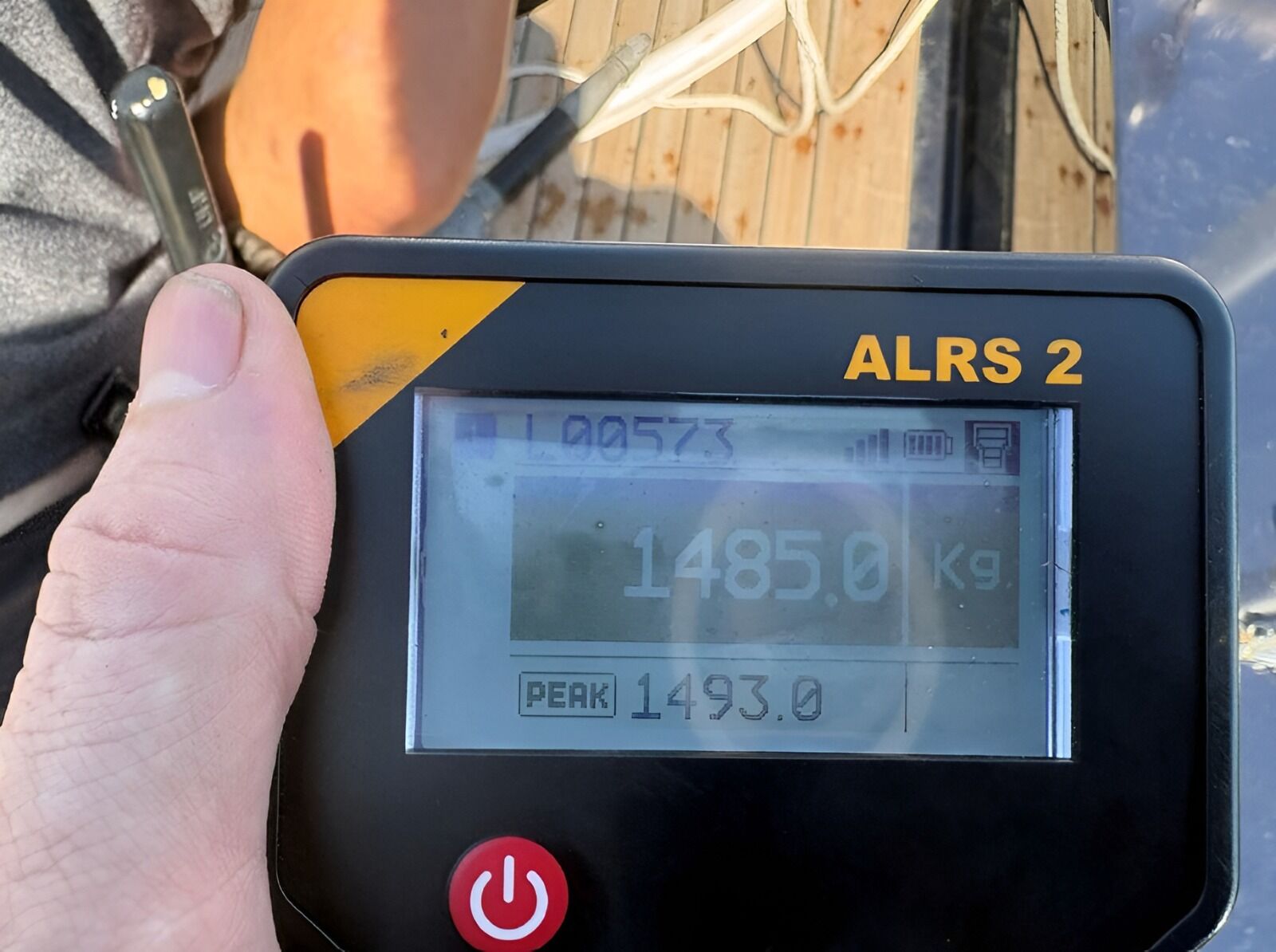
Once every five years, the lifeboat system gets its hardest test. The winch must lower and stop a load 10% heavier than the boat full of people and equipment. The hooks are taken apart, measured and checked for cracks, then put back together and tested with the same heavy load.
Nobody rides in the boat while it is lowered and braked. The weight comes from water bags or test weights placed in the boat. The work must be done by technicians certified for that make of equipment, working for the manufacturer or an authorised service firm. Many flags also want a class surveyor to watch.
The point is simple. A real abandon-ship is the one day the boat must work first time, fully loaded. The five-yearly test proves it can, with a margin.
Key points
- At least every five years, the winch brake is tested with a proof load of 1.1 × the boat plus its full complement of persons and equipment (SOLAS III/20.11.1.2).
- The brake is applied abruptly once the proof load reaches maximum lowering speed (MSC.402(96) §6.3.1).
- On-load release gear is overhauled and then tested under 1.1 × the fully loaded mass at least once every five years (SOLAS III/20.11.2.2).
- Overhaul means dismantling the hook units, checking tolerances and looking for cracks (MSC.402(96) §6.3.3).
- Only certified personnel of the manufacturer or an authorised service provider may do this work (MSC.402(96) §4.3).
- Persons count as 82.5 kg in lifeboats on cargo ships, free-fall lifeboats and all rescue boats; other lifeboats on passenger ships still use 75 kg (LSA Code 4.4.2.2.1, 4.7.2.1, 5.1.1.1, as amended by MSC.272(85)).
Continue this lesson free
The full lesson, the interactive tool “Work out a five-yearly proof load” and the check are open to signed-up learners. It's free, takes a minute, and opens every lesson in all three courses.
Sources
- Requirements for maintenance, thorough examination, operational testing, overhaul and repair of lifeboats and rescue boats, launching appliances and release gearIMO resolution MSC.402(96), 19 May 2016
- Amendments to SOLAS chapter III, regulations 3 and 20IMO resolution MSC.404(96), 19 May 2016, in force 1 January 2020
- Amendments to SOLAS (regulation III/20, launching appliances)IMO resolution MSC.216(82), 8 December 2006
- Amendments to the LSA Code (person mass of 82.5 kg)IMO resolution MSC.272(85), 4 December 2008, in force 1 July 2010
- Amendments to the LSA Code (launching appliance proof loads)IMO resolution MSC.425(98), 15 June 2017
- Amendments to MSC.402(96) (ventilation system)IMO resolution MSC.559(108), 23 May 2024
- Life-saving Appliances and SystemsRepublic of the Marshall Islands Marine Notice 2-011-37, Rev. Dec/2025
- Survival Craft, Rescue Boat and Launching Appliances – Testing, Servicing and MaintenanceLiberia Marine Notice SAF-005, Rev. 07/26
- MGN 560 (M+F) Amendment 2: requirements for life-saving appliancesUK Maritime and Coastguard Agency, 10 December 2021
- IACS UR Z17 Procedural requirements for service suppliersIACS, Rev.23, July 2026
- ABS Regulatory News: Brief MSC 111ABS, 22 May 2026
Free awareness training. Lifeboat Inspections is not authorised to issue training certificates, so none is given, and this course is not a qualification. It doesn't replace STCW survival craft training, manufacturer training or MSC.402(96) technician certification. The manufacturer's manual and your flag's rules always come first.