Annual and Five-Yearly Thorough ExaminationLesson 5 of 8
Davits, winches and the brake test
What the annual examination checks on davits and winches, how fast a boat may be lowered, and how the empty-boat brake test is done.
13 minutes · For signed-up learners, free · Rules checked 20 October 2026 · Reviewed by the Lifeboat Inspections technical team
In plain words
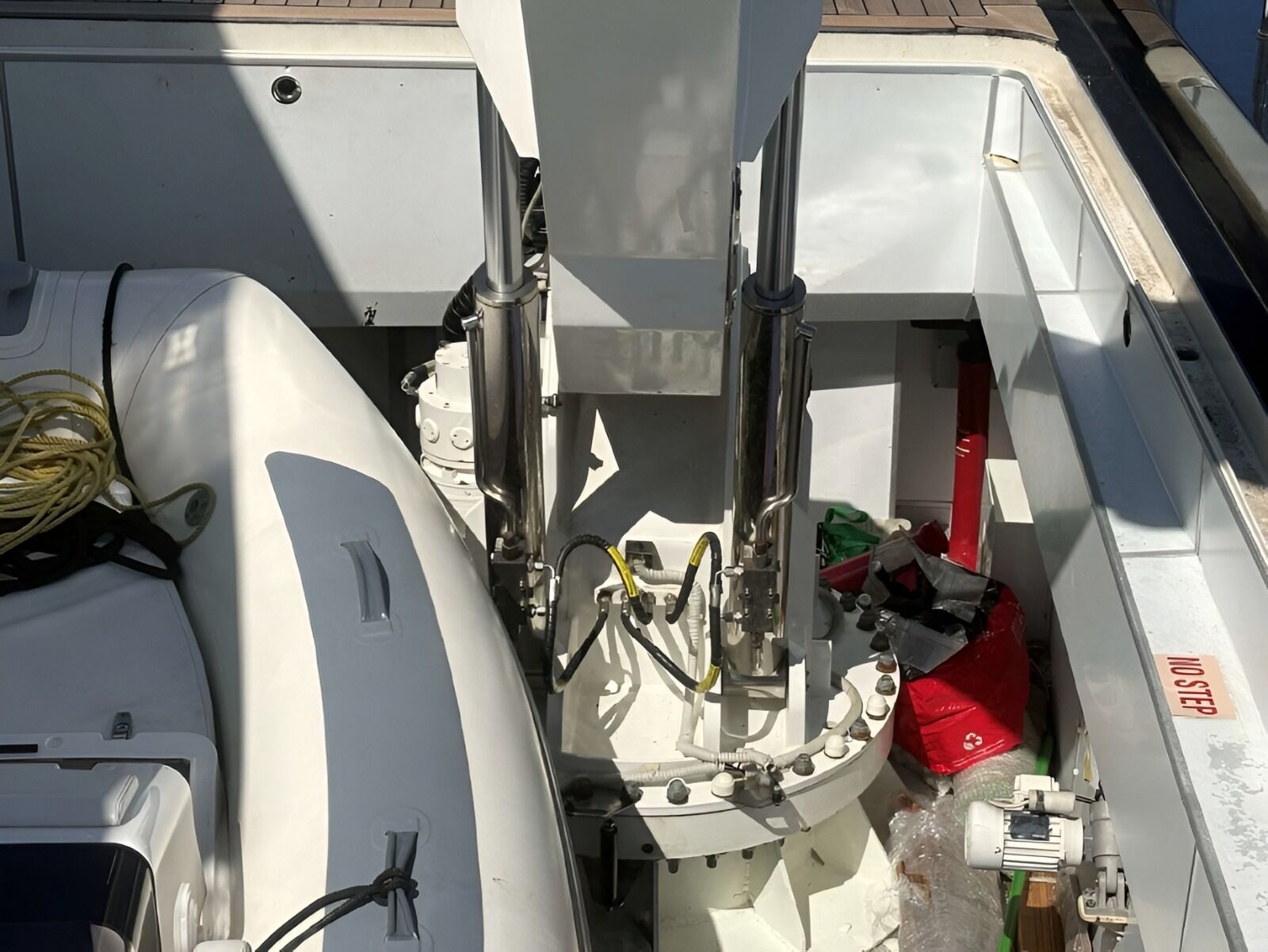
The davit and winch are the machine that puts the lifeboat in the water. The davit swings the boat out over the ship’s side. The winch holds the wires, called falls, and lets them out. A brake controls the speed and can stop the boat at any point.
Every year, a certified technician examines this machine. They look at the steel structure for rust, bending and loose joints. They check the wires and the wheels the wires run over. They test the switches that cut the power before the davit arms hit their stops. Then they lower the empty boat, let it reach full speed, and slam the brake on before it touches the water. The boat must stop and hold.
There is also a speed rule. A boat lowered too slowly stays too long beside a ship in trouble. A boat lowered too fast can hurt the people inside when it stops.
Key points
- The annual examination covers the davit structure, wires and sheaves, lubrication, limit switches, stored power, hydraulics and the winch brake, pads and foundation (MSC.402(96) §6.2.9).
- The annual brake test lowers the empty boat, or an equivalent load, and applies the brake abruptly at maximum lowering speed before the boat enters the water (MSC.402(96) §6.2.10).
- A manual brake must always be on unless the operator holds the control in the “off” position (LSA Code 6.1.2.12).
- The minimum lowering speed of a fully loaded boat is S = 0.4 + 0.02H m/s; for appliances installed on or after 1 January 2026 it is that figure or 1.0 m/s, whichever is less (LSA Code 6.1.2.8, MSC.554(108)).
- For appliances installed on or after 1 January 2026, the maximum lowering speed is 1.3 m/s unless the Administration accepts another figure (LSA Code 6.1.2.10, MSC.554(108)).
- Davits recovered by power need limit switches that cut the power before the arms reach the stops (LSA Code 6.1.2.7).
Continue this lesson free
The full lesson, the interactive tool “Work out the lowering speed limits” and the check are open to signed-up learners. It's free, takes a minute, and opens every lesson in all three courses.
Sources
- Requirements for maintenance, thorough examination, operational testing, overhaul and repair of lifeboats and rescue boats, launching appliances and release gearIMO resolution MSC.402(96), 19 May 2016
- Amendments to SOLAS chapter III, regulations 3 and 20IMO resolution MSC.404(96), 19 May 2016, in force 1 January 2020
- Adoption of the International Life-Saving Appliance (LSA) CodeIMO resolution MSC.48(66), 4 June 1996
- Amendments to the LSA Code (hook reset, lowering speeds)IMO resolution MSC.554(108), 23 May 2024, in force 1 January 2026
- 2023 amendments to SOLAS (regulation II-1/3-13, lifting appliances)IMO resolution MSC.532(107), 8 June 2023
- Revised guidelines on safety during abandon ship drills using lifeboatsIMO MSC.1/Circ.1578/Rev.1, 6 July 2026
- Review of Lifeboat and Launching Systems' AccidentsUK MAIB Safety Study 1/2001, 1 February 2001
- Investigation report: lifeboat release on board Harmony of the Seas, 13 September 2016BEAmer, published by the Bahamas Maritime Authority, May 2017
- ABS Regulatory News: Brief MSC 111ABS, 22 May 2026
- Resolutions adopted by MSC 111Maritime and Port Authority of Singapore Shipping Circular No. 8 of 2026, 27 August 2026
Free awareness training. Lifeboat Inspections is not authorised to issue training certificates, so none is given, and this course is not a qualification. It doesn't replace STCW survival craft training, manufacturer training or MSC.402(96) technician certification. The manufacturer's manual and your flag's rules always come first.