Lifeboat Safety and the RulesLesson 1 of 8
Why lifeboats hurt people
The lifeboat accidents behind today's rules, what went wrong in each, and the rule or practice that now addresses it.
10 minutes · Open to everyone · Rules checked 20 October 2026 · Reviewed by the Lifeboat Inspections technical team
In plain words
A lifeboat is meant to save you on the worst day at sea. For many years, though, lifeboats hurt seafarers on ordinary days: during drills, tests and maintenance, with the ship safe alongside.
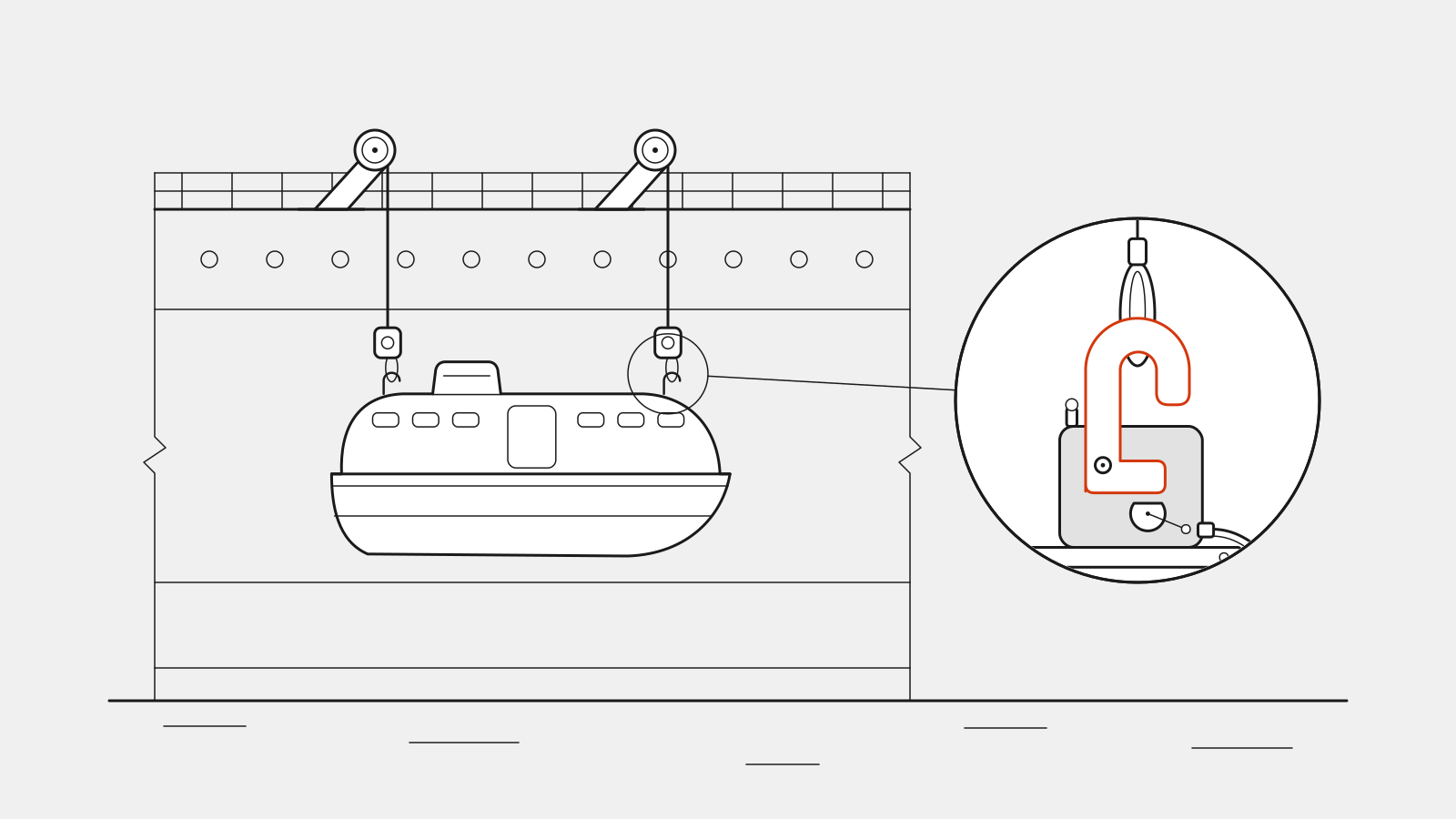
The pattern repeats. A hook opens when nobody meant it to. A wire breaks. A boat drops from the davit with crew inside. Some people fall several metres into the water, still strapped into the boat.
Investigators found the same causes again and again. Hooks were not fully reset. Equipment was badly maintained. People did not know the boat well enough, or did not talk to each other during the launch.
Almost every lifeboat rule you meet in this course answers one of those causes. If you know why a rule exists, you are much more likely to follow it when you are tired, rushed or sure that “it will be fine”.
Key points
- Over ten years, lifeboats and their launching systems killed 12 professional seafarers, 16% of all lives lost on merchant ships in the MAIB database, all during training or testing (MAIB Safety Study 1/2001).
- The MAIB found that “the most common cause of fatal accidents involving lifeboat launching systems is the failure of on-load release hooks” (MAIB Safety Study 1/2001).
- IMO lists the main causes: release mechanism failure or unintended operation, poor maintenance, poor communication, lack of familiarity, unsafe practices in drills and inspections, and design faults (MSC.1/Circ.1206/Rev.1).
- Since 1 January 2013, new on-load release hooks must meet stricter stability criteria, and older hooks that did not had to be replaced by 1 July 2019 at the latest (LSA Code 4.4.7.6, MSC.320(89); SOLAS III/1.5, MSC.317(89)).
- The weekly inspection includes checking that on-load release gear is “properly and completely reset” (SOLAS III/20.6.1).
- No maintenance or adjustment of release gear may be done while the hooks are under load (MSC.402(96) §6.2.4).
The detail
What the numbers say
In 2001 the UK Marine Accident Investigation Branch (MAIB) published a study of the lifeboat accidents reported to it over ten years. Its foreword is blunt: over a ten-year period, lifeboats and their launching systems “have cost the lives of 12 professional seafarers, or 16% of the total lives lost on merchant ships. Eighty seven people have been injured.” Every one of these accidents happened during training or testing, not in a real emergency (MAIB Safety Study 1/2001).
The study sorted its database by the part that failed:
| Part involved | Incidents | Injuries | Deaths |
|---|---|---|---|
| Hooks | 11 | 9 | 7 |
| Tricing and bowsing | 10 | 5 | 2 |
| Falls, sheaves and blocks | 12 | 19 | 2 |
| Engine and starting | 18 | 15 | 0 |
| Gripes | 12 | 10 | 0 |
| Winches | 32 | 8 | 0 |
| Davits | 7 | 7 | 0 |
| Free-fall | 2 | 1 | 0 |
| Weather | 2 | 0 | 0 |
| Not otherwise classified | 19 | 13 | 1 |
Winches caused the most incidents, but hooks caused the most deaths. The MAIB concluded that “the most common cause of fatal accidents involving lifeboat launching systems is the failure of on-load release hooks”. It also noted that the SOLAS requirement for on-load and off-load release on ships built after 1 July 1986 had led to “over-complicated” hook designs.
Steamship Mutual noted in 2007 that there were no complete worldwide figures. An industry survey from 2000 by OCIMF, INTERTANKO and SIGTTO found that most accidents happened “during routine drills and maintenance activities at the human/mechanical interface”, according to the same Steamship Mutual article.
Cases you should know
| Year | Ship or place | What happened | Source |
|---|---|---|---|
| 2000 | Vancouver | Three crew killed and one injured during a lifeboat launch | As reported by Steamship Mutual (TSB Canada investigation) |
| 2004 | RFA Fort Victoria | During a release gear test with seven people aboard, the boat was released about 1.2 m above the water; people were injured on landing | As reported by Steamship Mutual |
| 2011 | CMA CGM Christophe Colomb | A lifeboat fell during a drill with three crew aboard: two died and one was seriously injured. The hardware failure was traced to the building shipyard | Cited in the BEAmer Harmony of the Seas report |
| 2013 | Thomson Majesty, La Palma | While a lifeboat was being hoisted with eight crew aboard after a drill, its forward wire rope fall parted. The boat swung on the aft hook and fell about 20 m: five died and three were injured | As reported by MarineLink, from the Transport Malta Marine Safety Investigation Unit report |
| 2016 | Harmony of the Seas, Marseille | A lifeboat fell into the sea during a drill with five crew aboard: one died and four were injured | BEAmer investigation report |
Harmony of the Seas, 13 September 2016
The French investigation body BEAmer investigated this accident on a Bahamas-flagged cruise ship. During an abandon ship drill, lifeboat 14 was being lowered with five crew aboard. The forward lashing gripe had not been released. When the operator released the winch brake, the boat tilted heavily. The light stop pawls on the hooks did not hold under the violent movement, and the long links slipped out of both hooks. The boat fell into the sea. One crew member died and four were injured.
The report found several contributing factors. Roles were unclear. There was no step where someone cross-checked that the gripes were clear. Nothing mechanical stopped the boat being lowered by gravity while a gripe was still in place. The stop pawls did not hold the links when it mattered. After the accident, the owner added an unmanned test lowering before anyone boards.
Notice that no single person “caused” this accident. A missed step, a missing cross-check and a weak part lined up. That is typical.
What keeps going wrong
IMO collected the causes in MSC.1/Circ.1206/Rev.1, “Measures to prevent accidents with lifeboats”. Most accidents fell under these headings:
- Failure of the on-load release mechanism.
- Inadvertent operation of the on-load release mechanism.
- Inadequate maintenance of lifeboats, davits and launching equipment.
- Communication failures.
- Lack of familiarity with lifeboats, davits, equipment and associated controls.
- Unsafe practices during lifeboat drills and inspections.
- Design faults other than on-load release mechanisms.
Only two of the seven are purely about hardware. The rest are about people, training and routine.
How the rules answered
| Problem | What the rules now require |
|---|---|
| Hooks not fully reset | Weekly check that on-load release gear is “properly and completely reset” (SOLAS III/20.6.1) |
| Hooks opening under load | Stricter hook stability criteria for new hooks from 1 January 2013 (LSA Code 4.4.7.6, MSC.320(89)); older hooks replaced by 1 July 2019 at the latest (SOLAS III/1.5) |
| Hooks that can hold a load when only half reset | From 1 January 2026, new hooks must not be able to support any load unless completely reset (LSA Code 4.4.7.6.8, MSC.554(108)) |
| Adjusting gear while loaded | “No maintenance or adjustment of the release gear shall be undertaken while the hooks are under load” (MSC.402(96) §6.2.4) |
| Worn or badly terminated falls | Renewal at least every five years (SOLAS III/20.4); bulldog grips banned on primary load-bearing terminations by the Marshall Islands (MN 2-011-37) and Liberia (SAF-005) |
| Poor servicing | Annual and five-yearly work only by certified people from the manufacturer or an authorised service provider (MSC.402(96) §4.2–4.3), mandatory since 1 January 2020 |
| Unsafe drills | IMO guidelines on safety during abandon ship drills, now MSC.1/Circ.1578/Rev.1 (6 July 2026) |
The service technicians’ own training must now include the “causes of lifeboat and rescue boat accidents” (MSC.402(96) §8). This lesson is your version of that.
What this means for you
Treat every drill, test and inspection as the moment when accidents actually happen. Follow the manufacturer’s manual for your boat. Check the hooks yourself. Speak up if a step is missed. The rest of this course shows you how.
Deep dive
Why “over-complicated” hooks appeared
The MAIB study linked the problem to a SOLAS change. Ships built after 1 July 1986 had to have release gear with both on-load and off-load capability, so hooks had to be able to open with the weight of the boat still on them. In the MAIB’s view, this led to “over-complicated” designs.
IMO’s later answer is visible in the 2011 hook criteria. A fully reset hook must be designed so that “the weight of the lifeboat does not cause any force to be transmitted to the operating mechanism”, and locking devices must not be able to “turn to open due to forces from the hook load” (LSA Code 4.4.7.6, MSC.320(89)). In other words, a correctly closed hook must stay closed by itself. Lesson 4 looks at this in detail.
The MAIB comparison
The MAIB set its 12 lifeboat deaths against the other 73 deaths over the same period. Lifeboat-related deaths equalled each of the two largest other causes: enclosed spaces (12) and falls overboard (12). Enclosed space entry later got its own mandatory drills (SOLAS III/19.3.3, from 1 January 2015).
Reading investigation reports
Investigation reports aim to prevent the next accident, not to blame. When you read one, look for the chain: the condition of the equipment, the procedure, what people knew, and what nobody checked. You will usually find the same chain on your own ship, waiting for one more link.
Try it
Explore the accident timeline: this interactive tool needs JavaScript turned on.
Check yourself
5 questions.
-
The MAIB Safety Study 1/2001 states that “the most common cause of fatal accidents involving lifeboat launching systems is the failure of on-load release hooks”. Winches caused the most incidents, but hooks caused the most deaths.
-
The MAIB found that the lifeboat deaths and injuries in its database all happened during training or testing, not in real emergencies (MAIB Safety Study 1/2001).
-
MSC.1/Circ.1206/Rev.1 lists lack of familiarity alongside release mechanism failure, inadequate maintenance, communication failure, unsafe practices and design faults.
-
The BEAmer report found that the forward lashing gripe was still in place. The boat tilted, the light stop pawls did not hold under the violent movement and the links slipped out of both hooks.
-
SOLAS III/20.6.1 says the weekly inspection includes “the condition of hooks, their attachment to the lifeboat and the on-load release gear being properly and completely reset”.
Want your scores saved? Sign up free and every lesson opens too.
Sources
- Review of Lifeboat and Launching Systems' AccidentsMAIB Safety Study 1/2001, 1 February 2001
- Investigation report: lifeboat release on board Harmony of the Seas, 13 September 2016BEAmer, published by the Bahamas Maritime Authority, May 2017
- Cruise ship tragic lifeboat accident: investigation reportMarineLink, on the Transport Malta Marine Safety Investigation Unit report, 12 May 2014
- Risks in launching and recovery of lifeboatsSteamship Mutual
- Measures to prevent accidents with lifeboatsIMO MSC.1/Circ.1206/Rev.1, 11 June 2009
- Survival Craft, Rescue Boat and Launching Appliances – Testing, Servicing and MaintenanceLiberia Marine Notice SAF-005, Rev. 07/26
- Life-saving Appliances and SystemsRepublic of the Marshall Islands Marine Notice 2-011-37, Rev. Dec/2025
- Amendments to SOLAS (weekly and monthly inspections, III/20)IMO resolution MSC.152(78), 20 May 2004
- Amendments to SOLAS (falls, III/20.4)IMO resolution MSC.216(82), 8 December 2006
- Amendments to the LSA Code (release mechanisms, 4.4.7.6)IMO resolution MSC.320(89), 20 May 2011
- Amendments to SOLAS (hook replacement, III/1.5)IMO resolution MSC.317(89), 20 May 2011
- Amendments to the LSA Code (hook reset, lowering speeds)IMO resolution MSC.554(108), 23 May 2024
- Requirements for maintenance, thorough examination, operational testing, overhaul and repair of lifeboats and rescue boats, launching appliances and release gearIMO resolution MSC.402(96), 19 May 2016
- Amendments to SOLAS (enclosed space drills, III/19)IMO resolution MSC.350(92), 21 June 2013
- Revised guidelines on safety during abandon ship drills using lifeboatsIMO MSC.1/Circ.1578/Rev.1, 6 July 2026
Free awareness training. Lifeboat Inspections is not authorised to issue training certificates, so none is given, and this course is not a qualification. It doesn't replace STCW survival craft training, manufacturer training or MSC.402(96) technician certification. The manufacturer's manual and your flag's rules always come first.